
Women Lead Land Restoration and Climate Resilience in Eastern Uganda
Through agroforestry, food forests and collective action, women confront climate impacts while restoring degraded landscapes and strengthening their communities. At the same time, they challenge the structural inequalities that limit their access to land, resources and decision making, showing that climate action cannot be effective or just without securing women’s rights.
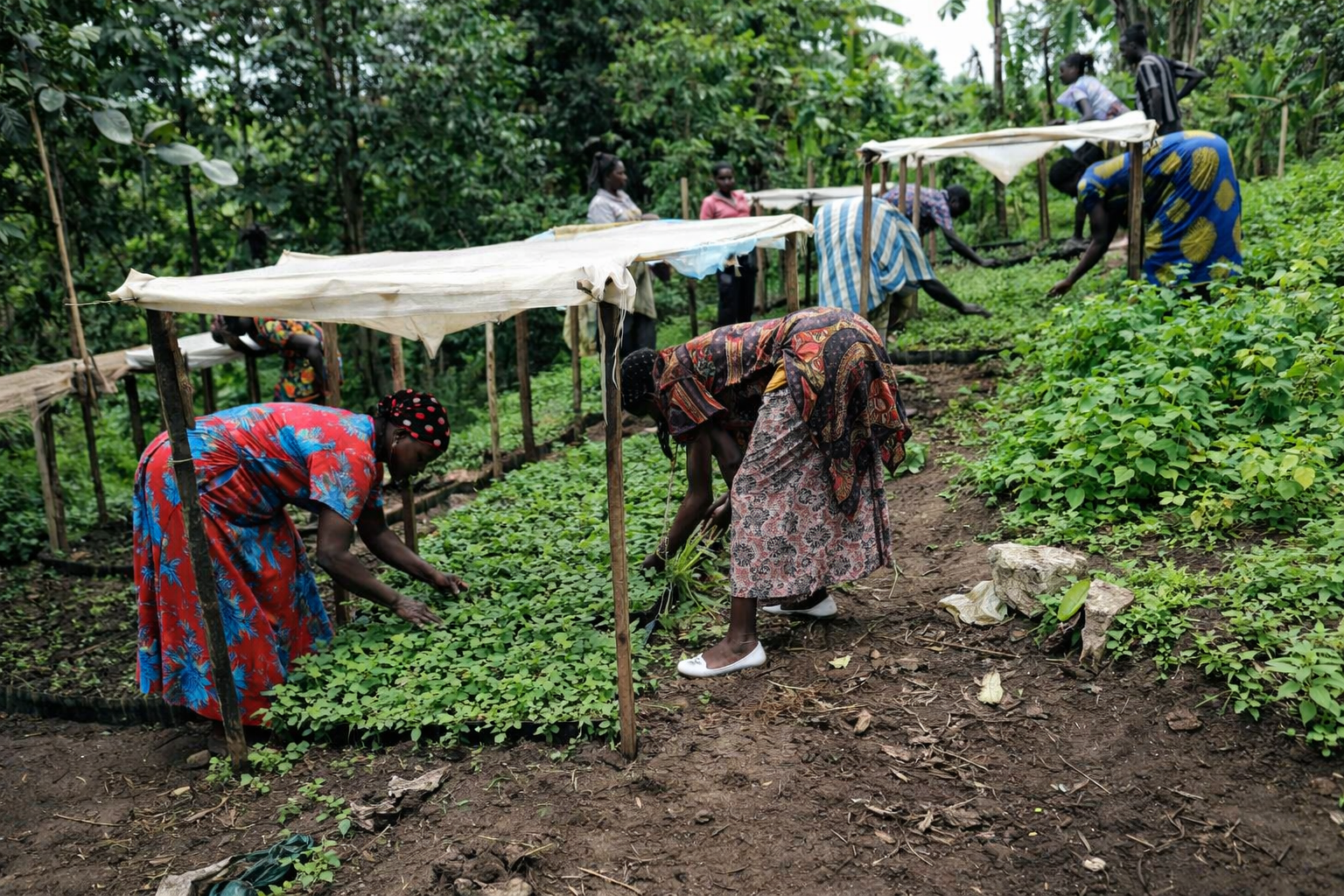
Women group members tending to the nursery seedbed, learning smart agriculture.
Photo by Beth Nambozo
When women restore the land but have no rights over it
Betty Bugosi Wodeya is among the Ugandan women actively restoring unproductive landscapes through food forests, agroforestry and sustainable land management practices, often supported by goodwill organizations and government projects. These efforts address deforestation and environmental degradation while improving household incomes, nutrition, and access to education and healthcare. Yet despite their crucial role in food production, women like Betty face persistent barriers in accessing land, productive resources, equitable benefit sharing and workload management. Rural Development Media and Communication, funded by Both ENDS Netherlands, is one organization working with twelve women farmer groups in the Mt. Elgon area to address these challenges. Our target is to reach 500 households.
How women restore ecosystems through their knowledge and analog forestry
In Eastern Uganda’s Sironko and Bulambuli districts, the slopes of Mount Elgon meet plains that extend up to the swamps of Sironko and Mpologoma rivers, which flow toward Lake Kyoga in central Uganda. Here, women are working to restore their land and share the benefits of growing indigenous trees with their communities. Farmers once enjoyed fertile soils and reliable weather, but over the past 20 years, rainfall has become increasingly erratic. Frequent flooding now causes the districts’ main rivers to overflow, destroying homes and washing away gardens. Together, women have committed to planting indigenous trees to protect their environment from floods and hunger.
Women have embraced Analog Forest (AF) training opportunities as a transformative experience in their communities, planting indigenous trees around their homesteads and farmlands. However, women still face challenges accessing vital natural resources like land and forests, the very foundation of their livelihoods. During our AF project visit at Buhugu sub-county, one of the pilot project areas with eight women’s groups, we gathered testimonies from training participants. Below are their voices in their own words.
I gained tremendous insight from the various trainings and farmer to farmer learning in our sub-county on agriculture and smart farming”, explains Madam Jesca Nakayenze, a sub-county councilor for the elderly in Buhugu. “These sessions helped us respond to climate change effects and reduce the impact on long droughts in the community. I had the opportunity to network and answer many of my questions on sustainable agriculture while visiting model farmers’ gardens in our community of greater Buhugu sub-county”. Jesca added that, “as a counselor at the sub-county, I will advocate and lobby for women’s rights to access land in their households so they can demonstrate what they learn from the various trainings”.
Mr. Wodeya Andrew, an active participant in the training, affirmed the strength of women by giving an example of his wife, Betty Bugosi Wodeya, who transformed the household income when she took over management of the farm and livestock. Wodeya shared that his wife now manages the cattle and produces 50 liters of milk per day, which she sells to pay school fees for the four children in boarding school. He never regrets his wife’s efforts in bringing joy to the family, he concludes.
Madam Patience Mugide, one of the model farmers, shared her insights during an on-farm visit. While showing members her analog forest demonstration adjacent to the River Sironko banks, where soils are regularly washed away during flooding. Mugide emphasises the value of planting trees, especially of indigenous species.
She pointed out that many farmers dig up to the river banks and destroy the waterways, causing soil erosion and silting of water bodies. This has led to a lot of suffering especially during the rainy season.
With her expertise as an Agriculture officer, she helped identified suitable tree species. Grevillea Robusta, though an exotic species, is a high nitrogen fixer that can be grown with any crops and works well in all farming systems, including banana and coffee plantations. Other species, such as exotic Alnus Acuminate, improved umbrella trees, Milicia excels (improved muvule tree) as well as native Markhamia Lutea and Misola are suitable for planting along boundaries in the different farming systems of Uganda.
She explained that community members were interested in marking their boundaries and needed the best tree species for this purpose. She identified Vepris Nobills (native) locally called Kicameri (a fruit tree), as very good for farmland. Artocarpus heterohyllus (Ffene) is suitable for boundary planting but less ideal for on-farm use, as its leaves do not decompose easily to form nutrients.
She further advised that while fruit trees like Kicameri are beneficial, they can cause disputes over ownership when planted on boundaries. They are best planted in home compounds instead. Trees recommended for farmland include Kyibere (used for making pounding mortal), Gukuyu, Mu dodo and Miluku among others.
Mugide concluded by requesting that farmer-to-farmer learning be upheld. She stressed that more training is needed to help the community- especially farmers, understand climate change, climate justice, and women’s rights to access land and natural resource management. She added that government efforts to address these the community issues are too slow.
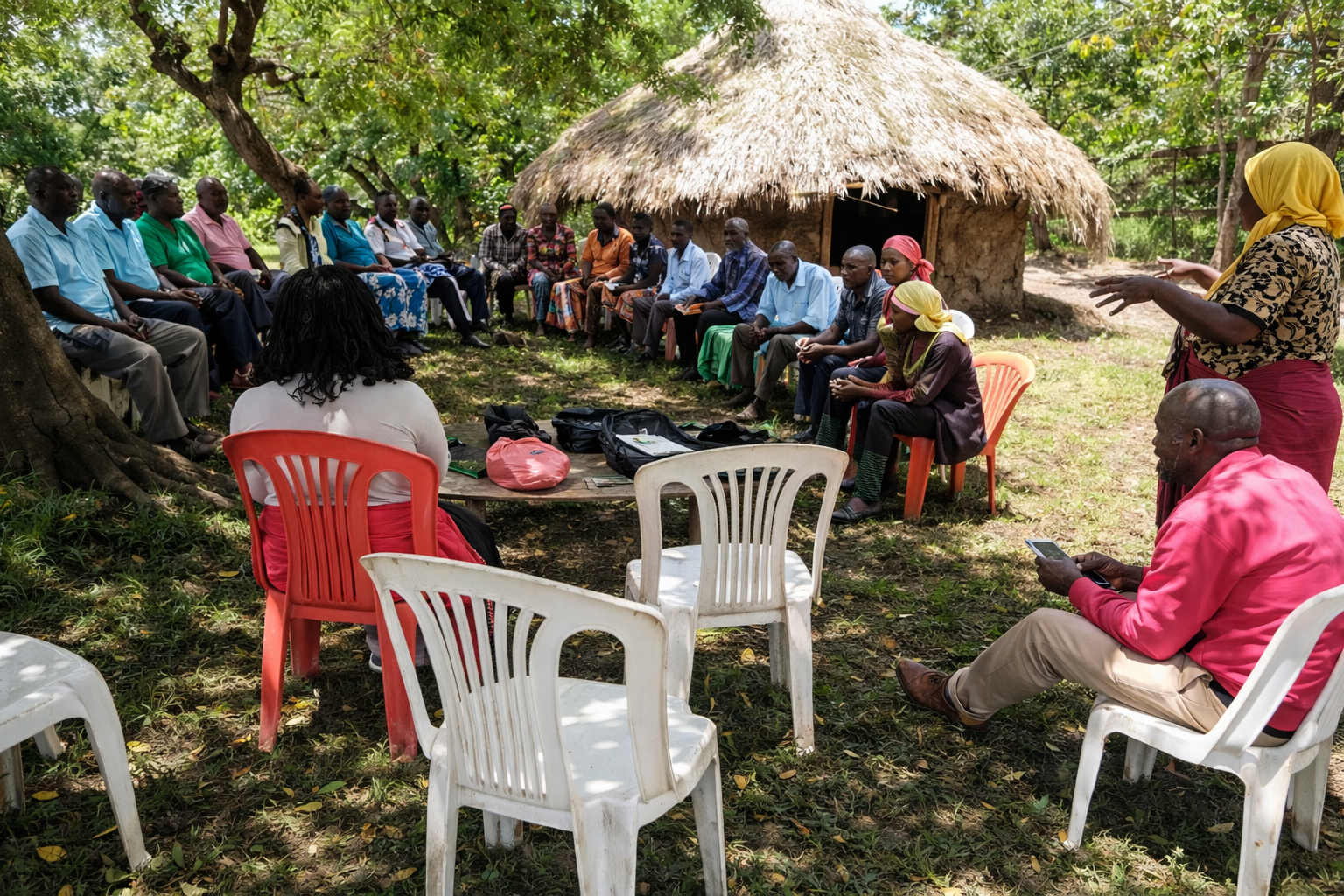
Sarah Kisolo AF Networker coordinator introducing technical officials to the community, Forestry and Gender officers.
Photo by Beth Nambozo
How women are reclaiming land, livelihoods and climate resilience
In Bulambuli district, we visited women’s groups who requested more tree nursery beds. Farida Kakai, a leader of Bufukula parish’s Nabbongo women group, points at the plain land fields and stresses that “women do not plant only trees but they plant hope for the future generation”. She referred to the long drought and food shortage that occurred over the past three years, followed by floods that swept away all the topsoil. Kakai emphasised, “It is because of bare lands with no vegetation, and we cannot continue like that when we have big families to feed. Women should take the lead to plant trees with help from technical people”.
Sarah Madanda, the Environment Officer for Bulambuli district, says that rainfall patterns in the district have changed dramatically. “We used to expect rains by the first week of March, but now they start in May. The second season we expect the rains in mid-August, but sometimes they come in mid-September. Floods have become a common phenomenon- even in areas without rivers- washing away crops, homes, and livelihoods,” she tells the RUDMEC team. Madanda adds, “The temperatures, seasons, and patterns of rainfall and drought have all shifted noticeably. In the past 10 to 20 years, we have seen prolonged droughts and intense, shorter rainfalls that are insufficient for crop yield and production.”
In response to this situation, the Ugandan government and Civil Society Organizations have promoted tree planting as a solution. They are encouraging people in mountainous districts to plant native species, which are more resistant to pests and diseases and offer ecological and socio-economic benefits.
Why restoring land without women’s rights is not climate action
Mr. Mwangale Micheal, a professional forester working with National Environment Management Authority (NEMA), leads the Mt. Elgon Conservation Project and works with RUDMEC as a technical advisor to train communities on tree planting. He explains that indigenous tree species grow more slowly than exotic trees like Pine and Eucalyptus. For economic reasons, some people prefer exotic trees because they provide quick commercial timber and firewood. However, indigenous trees remain the best choice. They enrich soil, support agroforestry and food forests, provide fodder and shade, control soil erosion, and offer many other benefits, from medicinal and construction uses to biofuel .
Mwangale notes that every season, farmer groups and individuals approach them for indigenous tree seedlings. He stresses that “it’s not just about planting trees, but about understanding their purpose and the value they play not only for human survival but also in the environment we live in”.
The tree seedlings include Milicia excelsa, Measopsis eminii, Entandrophragma angolense, Ugandan iron tree known as Cynometra alexandri, musambya, and ndagi among others.
Sarah Kisolo, General Secretary and Coordinator of Analog Forest Project for RUDMEC, pointed out that Sironko and Bulambuli districts have established tree nurseries managed by women and youths. These nurseries provide free tree seedlings, particularly to women, to support land restoration efforts. Reviving the planting and protection of these trees within Mount Elgon areas serves as both a practical response to environmental challenges and a step toward strengthening laws that support women’s access to land tenure and equitable sharing of natural resources in all communities. RUDMEC’s efforts are gaining recognition in the broader community, with local leaders in the two sub-counties and school teachers inviting interactions about the initiative. Some women are now teaching their children to plant and care for trees, ensuring that this legacy continues. RUDMEC, in collaboration with her local partner Kikandwa Environment Association (KEA), is grateful to the funding partners, which include Global Alliance for Green and Gender Action (GAGGA), Both ENDS and CENDEP of Cameroon. For the women folk, one step forward each day is still progress.
How to support women restoring the land and secure their rights
Support the women leading land restoration and analog forestry in their territories. Champion funding that secures their land rights, expands their access to productive resources, and ensures their meaningful participation in climate decision-making, like the work that RUDMEC advances in eastern Uganda. When women have control over land and the power to shape governance processes, restoration becomes more effective, equitable, and resilient for entire communities.
“Women do not plant only trees, they plant hope for future generations”
Connect with the organization

Share this story on social media


